A response category.
Autoflowering refers to flowering initiation that is not dependent on a change in photoperiod. Photoperiod means the duration of light and darkness in a daily cycle.
Field notes / 08 · A clearer comparison
Autoflower vs feminized seeds: what is the difference?
Autoflower describes flowering behaviour. Feminized describes the intended female outcome of a seed line. They are not mutually exclusive categories: a seed line can be described as both autoflowering and feminized.
Explore the comparison ↘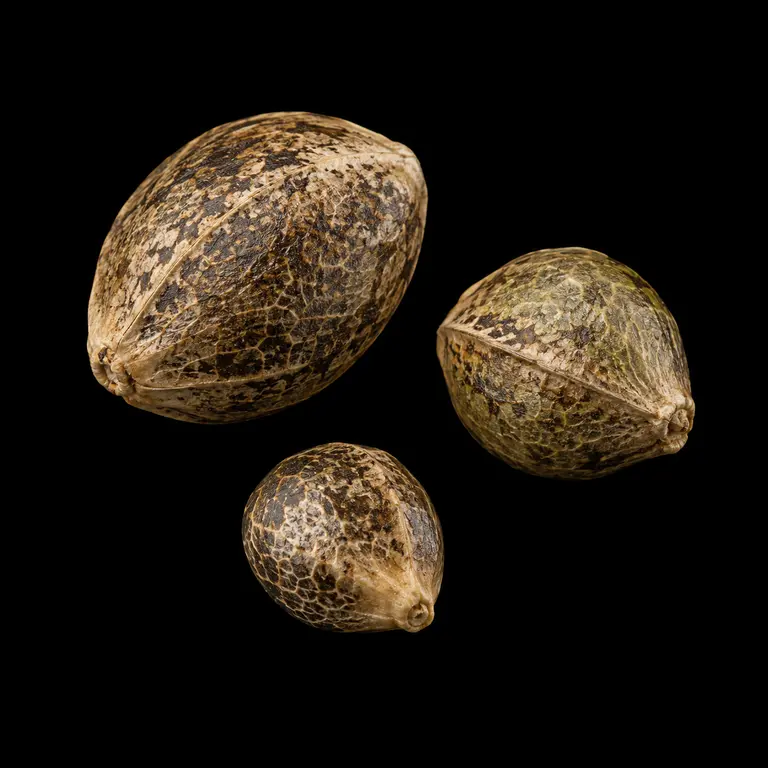
01 / One description, more than one trait
Select a label to highlight its explanation. The third option shows why both words can occur in the same description. This comparison explains terminology rather than prescribing cultivation choices.
Autoflowering refers to flowering initiation that is not dependent on a change in photoperiod. Photoperiod means the duration of light and darkness in a daily cycle.
Feminized describes seed material associated with a female reproductive outcome. The term concerns the breeding background and sex-related description, not the flowering-response category.
Feminized autoflower combines a sex-related description with a flowering description. Neither word cancels the other because the two words address different traits.
02 / Why the comparison can mislead
A comparison framed as autoflower versus feminized can suggest that one label excludes the other. The clearer distinction is between two questions: what flowering behaviour is described, and what sex-related category is described?
An everyday analogy is a book described as both illustrated and hardback. One word concerns its contents and the other its format. Seeing either word alone does not tell you whether the other also applies.
| Label | Main subject | Not supplied by the label alone |
|---|---|---|
| Autoflower | Flowering response | A female-only description or a complete set of product specifications |
| Feminized | Intended female outcome | Whether the line is autoflowering or photoperiod-sensitive |
| Photoperiod-sensitive | Flowering response associated with day length | A regular or feminized designation |
| Regular | A seed category that is not presented as feminized | A complete statement of flowering behaviour |
The table separates the meanings of the words. It does not establish the classification of an unnamed packet. That requires a description of the particular material, with its source, rather than an assumption drawn from how a website organises its menu.
A catalogue may place autoflower and feminized on separate navigation links for convenience. Menu structure is an editorial choice; it does not turn the categories into biological opposites. Read the full description when both traits matter to understanding what is being presented.
03 / Read the scientific vocabulary
This concerns the relationship between flowering and day length. Autoflowering is discussed in research as photoperiod-insensitive flowering. It is a description of a response, not a claim that the plant has no biological relationship with light.
A timing statement describes when a defined event occurs in the material being studied. A response category does not by itself supply a universal calendar duration. The event, subject and evidence still need to be specified.
The 2022 study of Autoflower1 and Early1 investigated genetic regions associated with flowering traits. A 2024 study identified another locus associated with photoperiod-insensitive flowering in hemp. Together, they show that the scientific topic involves genetic variation rather than a single marketing adjective.
Those findings do not supply identical specifications for every cultivar carrying an autoflower label. The practical reading lesson is to distinguish a general trait description from a claim about particular material. A shared label is not evidence that two named varieties match in every other characteristic.
Research on feminized cannabis seed examines sex expression and progeny. Its subject differs from studies of photoperiod response. That separation supports the central comparison here: the two labels concern different biological dimensions.
The term does not identify a distinctive seed-shell pattern. Our male or female seed article explains why a photograph should not be treated as a sex determination. Appearance and a documented category description are different kinds of information.
04 / Read the complete description
The phrase combines two compatible categories. It does not provide every other characteristic of the material, such as provenance or an independently reported result.
The phrase gives the sex-related category. It leaves flowering response unspecified unless the surrounding description supplies that information.
The phrase identifies flowering behaviour. It should not be expanded into a feminized claim merely because that combination is familiar.
These are examples of wording, not listings of available products. Their purpose is to show how much meaning a short label contains and where that meaning stops.
A familiar strain name may appear beside either label. The name does not erase the need to identify the variant being described. Likewise, two pages using the same name are not necessarily documenting the same material or the same source.
For the category context, visit Autoflower seeds and Feminized seeds. This comparison focuses on the relationship between their terms. For broader claims about quality and documentation, see our guide to reading seed-quality evidence.
Questions, untangled
Yes. Autoflower describes flowering behaviour, while feminized describes an intended female outcome. The terms can apply together.
No. Feminized does not by itself state the flowering-response category. That information needs to appear elsewhere in the description.
No. The autoflower label concerns flowering response. It does not, on its own, supply a feminized designation.
No. It names a response category. A duration requires a defined event and evidence about the particular material.
A photograph of a dry seed does not establish either classification. The illustrated seeds here are not presented as documented examples of particular categories.
Feminized vs regular · Autoflower vs photoperiod · Autoflower timing explainedFast flowering vs autoflowerLight and germinationGermination temperature explainedFrom germination to seedlingCannabis seedling appearanceMale and female plant biology
The wider context
Explore the central cannabis seed knowledge guide for an overview of biology, labels and related reading.