Activity begins inside.
Imbibition means water uptake. In seed physiology, this is associated with the beginning of the germination process. Internal activity and outward appearance are different kinds of observation.
Field notes / 03 · The knowledge library
Cannabis seed germination: biology, stages & timing
Inside a seed, the next plant already has a beginning. Discover the language scientists use to describe that transition, what a visible root represents, and why a germination-time claim needs more than a number.
Explore the stages ↘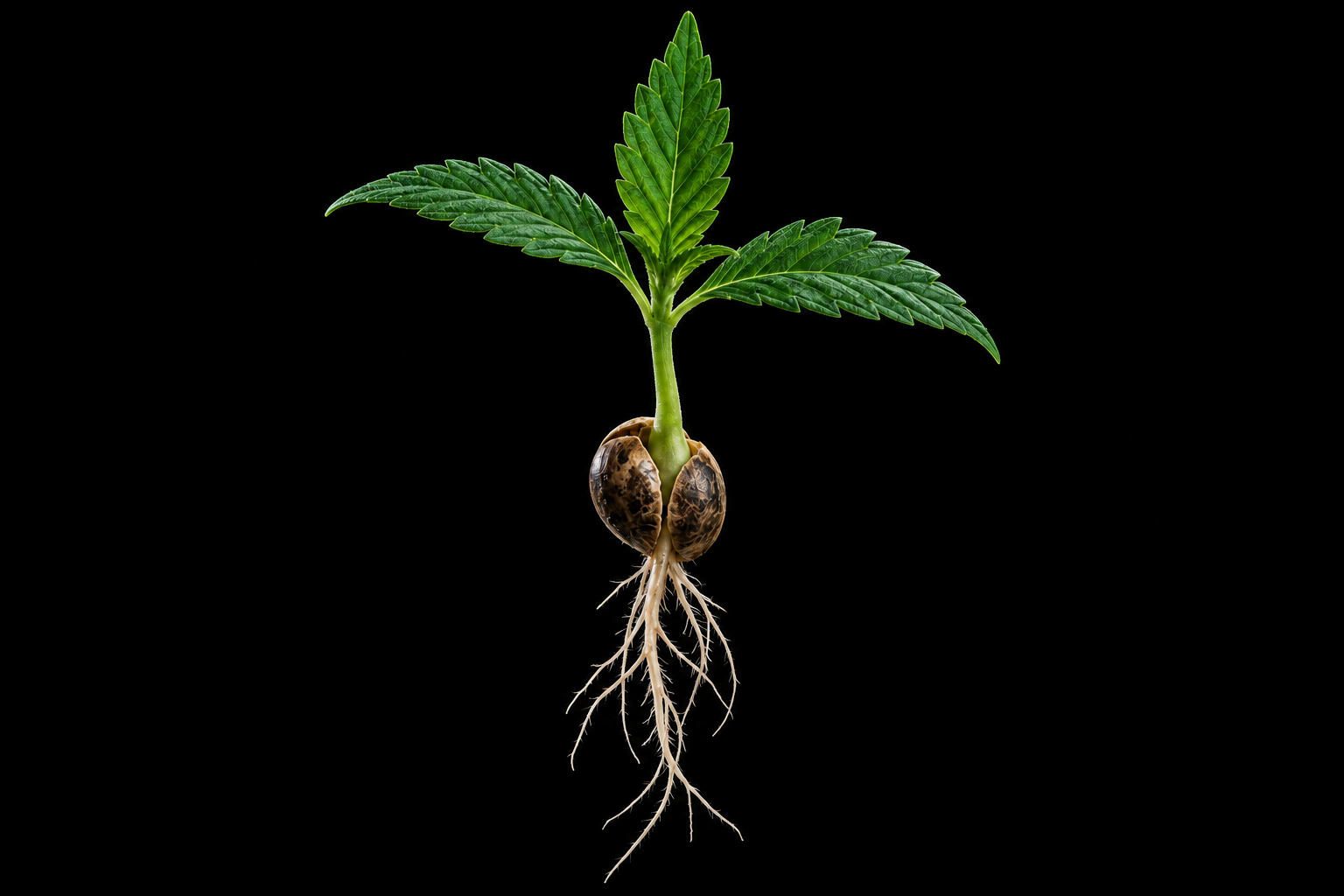
01 / A biological transition
Germination is a biological process, while a photograph captures only one view of it. These three chapters separate internal activity, the appearance of the embryonic root, and later seedling development. Select a chapter to highlight its explanation.
Imbibition means water uptake. In seed physiology, this is associated with the beginning of the germination process. Internal activity and outward appearance are different kinds of observation.
The radicle is the embryonic root. Its emergence through the surrounding tissues commonly marks completion of germination in physiological research. The word completion refers to that defined process, not a fully developed plant.
Subsequent seedling growth belongs to a later developmental chapter. A leafy plant image therefore represents more than the germination endpoint. Our illustration brings those ideas together symbolically.
The terminology above follows seed-physiology literature, including the 2024 review linked below. It describes biological events rather than practical cultivation methods.
02 / Small structure, rich biology
Kew describes three common features of flowering-plant seeds: an embryo, a food supply and a protective coat. The embryo contains the beginnings of the young plant; stored reserves support early development.
These parts make a seed more than a patterned shell. Its visible outline is only the outside of a structured biological package. Recognising that difference makes the language of germination much easier to follow.
The developing young plant within the seed. Think of this as a structural term: it identifies a part, rather than specifying a date, a commercial variety or a performance rating.
The protective outer tissue of the seed. A botanical description of this tissue answers an anatomy question. It should not be confused with a photograph-based claim about the entire specimen.
The embryonic root. This precise word helps distinguish a root-emergence observation from a more general statement that something has sprouted.
The young plant in the developmental period following germination. A caption using this word may be describing a later scene than a caption recording radicle emergence.
In ordinary conversation, “sprouting” can cover several of these events. In a scientific paper, the author usually needs a narrower definition. Neither style of language is inherently confusing; problems arise when an everyday phrase is treated as though it were a precisely defined measurement.
03 / What does germination time mean?
Before comparing two durations, identify the event that starts each clock and the event that stops it. This is a general principle of measurement. A duration without those definitions leaves the reader guessing about what was actually observed.
For example, a caption about the first visible root and a caption about a leafy seedling refer to different endpoints. Even if both use the word germination, their durations would not automatically answer the same question. A more precise label prevents a false comparison before any arithmetic begins.
| Look for | What it clarifies |
|---|---|
| Starting event | Which recorded event defines the beginning of the interval? |
| Endpoint | Does the result refer to a root, a seedling or another stated observation? |
| Subject | Does the description concern one specimen, a sample or a broader population? |
| Statistic | Is the number a first observation, a mean, a median or a range? |
| Source | Can the number be traced to an identifiable report with those definitions? |
The first recorded event in a group is an extreme observation. An average summarises a set of observations. A final count reports how many met a stated criterion. These descriptions can all be correct while telling different stories about the same group.
Consider a fictional museum display: one label gives the first date a specimen was photographed, while another summarises all photographs in the collection. The labels do not contradict each other; their subjects differ. Timing claims deserve the same attention to scope.
This guide therefore does not assign a universal cannabis germination deadline. Its purpose is to explain what timing language means, so readers can recognise whether two published statements are even comparable.
04 / Separate the questions
The Plant Cell review describes dormancy and germination as closely connected but distinct states. Dormancy can delay germination; it is not another name for death. Researchers study genetic and physiological regulation to understand this relationship.
That scientific distinction matters when reading a sentence such as “no germination was recorded.” The sentence reports an observation. Adding an explanation requires further evidence. An observation and the reason for that observation should remain separate in the account.
A report states what its observer detected within its defined scope. Read that statement before considering any explanation attached to it.
An interpretation connects evidence to an explanation. It should show its reasoning rather than silently replace the original observation.
A wider claim extends beyond the original subject. Ask whether the evidence actually supports that additional step.
A photograph of a root can illustrate a visible feature. A single image cannot, by itself, establish the elapsed time before that feature appeared. A time-lapse sequence adds a sequence of views, but its caption still needs to identify the subject and explain how time is represented.
Illustrations serve a different purpose. They can place several ideas together for clarity, exaggerate proportions or omit background details. The image at the top of this guide is labelled as a symbolic botanical illustration for that reason. It is not evidence for a cultivar’s appearance or its development speed.
A familiar name on a page does not supply the missing start point, endpoint or sample record behind a timing claim. Our White Widow profile explores how strain identity and source attribution fit together.
Dates become more useful when their events are named. The storage and shelf-life guide develops this distinction, while our appearance guide focuses on interpreting visible features.
Questions, untangled
Not necessarily. Physiological descriptions commonly use radicle emergence as the endpoint. A leafy seedling represents later development, so its image should not be read as a universal picture of the germination endpoint.
No. A duration describes time between defined events. A percentage describes a proportion of a defined group. Neither number can replace the other without changing the question.
No. Dormancy is a distinct biological concept. It should not be used as a synonym for loss of viability.
It documents a view. A claim about elapsed time needs a record connecting the relevant events, not just an image of the endpoint.
General research provides the biological vocabulary. Applying an individual study’s result to cannabis, or to a named variety, is a separate claim that needs its own evidence. The sources here explain concepts rather than cultivar-specific schedules.
Light and germination · Germination temperature explainedFrom germination to seedlingCannabis seedling appearanceMale and female plant biology
The wider context
Explore the central cannabis seed knowledge guide for an overview of biology, labels and related reading.