An oval outline.
Kew’s botanical account describes the fruit as ellipsoid to nearly spherical and slightly compressed. That is a range of forms, not one exact silhouette.
Field notes / 01 · The knowledge library
Cannabis seed appearance & quality
A visual knowledge guide to the outer structure, natural variation and identity of cannabis seeds. Learn how botanical descriptions work, what quality claims mean and how to read the evidence behind them.
Explore the details ↘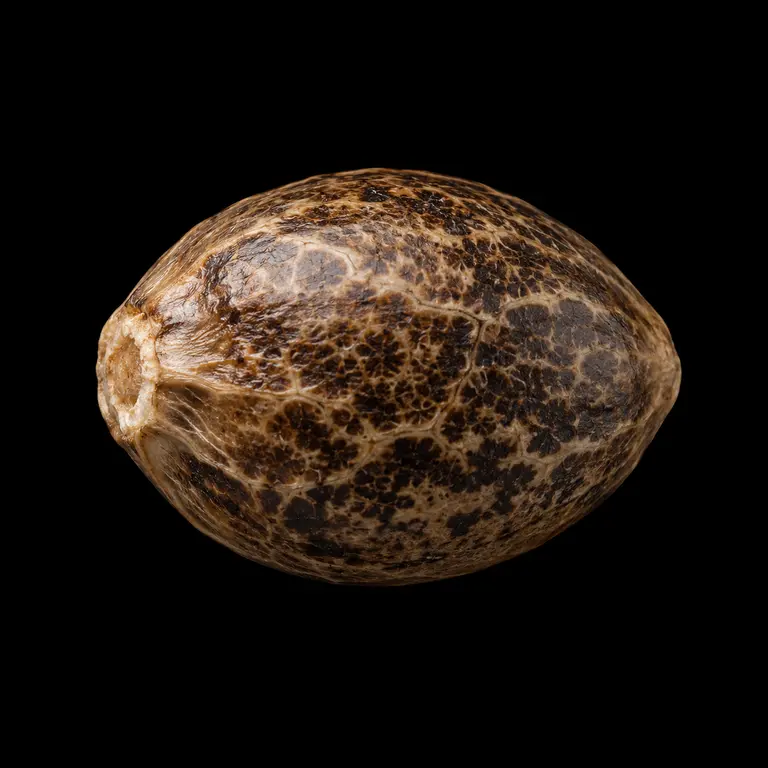
01 / The visible details
Choose a detail to explore. The illustration is a visual aid, not a reference specimen.
Kew’s botanical account describes the fruit as ellipsoid to nearly spherical and slightly compressed. That is a range of forms, not one exact silhouette.
The descriptions collated by Kew include pale networks and mottled or marbled surfaces. A decorative pattern is an appearance description; it is not a cultivar label.
Greyish and brownish colours appear in Kew’s account. The illustration shows one interpretation of that range, rather than a colour chart for grading seeds.
02 / A botanical detail
What is commonly called a cannabis seed is botanically an achene: a dry, one-seeded fruit. That is why scientific descriptions may use “fruit” where everyday language uses “seed”.
The distinction helps when reading a botanical source. The visible outer structure and the seed inside are related, but they are not quite the same thing.
A closer vocabulary
This is the botanical fruit described above. Everyday seed photography normally shows this complete outer unit, not a dissected view of the seed inside it.
Botanical writing calls the fruit wall the pericarp. It is distinct from the seed coat. Calling every visible layer a shell is convenient in conversation, but less precise in an anatomical description.
The seed is contained within the fruit. A surface illustration does not show all of its internal structures. A cutaway drawing would answer a different question from an exterior photograph.
These terms explain why two sources can appear to use different names for the same pictured object. One may use the everyday word seed; another may describe the fruit as an achene. Before comparing their claims, check which structure each author is discussing.
Looking at variation
Botanical descriptions describe ranges. Our enlarged illustration is deliberately labelled as an illustration because it cannot document the dimensions, provenance or exact colours of a real specimen.
Imagine photographing an oval object from above, then turning it onto its side. The outline changes even though the object does not. Compare like views before describing two seeds as differently shaped. A face-on image and a tilted image do not provide the same visual information.
A small object can fill an entire screen. Without a ruler, scale bar or recorded measurement, image size tells you about the photograph rather than the object. Enlarging a photograph adds display pixels, not a physical measurement of the specimen.
A highlight can make a surface look lighter or shinier. A shadow can hide part of its pattern. When describing an image, distinguish the visible lighting from the feature you want to describe. Edited contrast and colour should not be mistaken for a measured property.
A useful reference caption identifies the subject, contributor and image type. A photograph, an illustration and a microscope image have different purposes. Where known, specimen details and scale make the image more informative than a cultivar name alone.
03 / Observation is not a verdict
Quality is an umbrella word. Appearance, identity, analytical purity and a measured biological property are different questions. A clear description names the property instead of using “premium” as if it were a test result.
Shape, colour and surface pattern belong to a visual description. A photograph can document those visible details, provided its scale and source are clear.
A name in a caption is a claim about the subject. Contributor and specimen information make that claim traceable; a beautiful image alone does not authenticate it.
If a description claims a measured property, look for the relevant evidence. Do not turn the colour or polish of an illustration into a test result.
| Claim | What it concerns | What to look for in the record |
|---|---|---|
| Appearance | Visible colour, outline and surface. | A documented image, viewpoint and scale where relevant. |
| Identity | Which species or named material is represented. | A traceable specimen or lot reference and the basis for identification. |
| Analytical purity | The composition of the examined sample. | A report distinguishing pure seed, other seeds and inert matter. |
| A measured result | A specific property assessed in a test. | The named method, tested sample, date and reported scope. |
ISTA’s laboratory guidance treats analytical purity as a defined assessment of sample composition. In that context, “pure” does not simply mean attractive, and it does not by itself establish a named cultivar’s genetic identity. This is general seed-testing terminology, not a claim that the material on this site has an ISTA certificate.
Seed-testing records distinguish the submitted material from the larger lot it may represent. The relationship between sampling, testing and the report matters. A result cannot be applied to unrelated material merely because the names on two labels match.
For example, a report labelled “Sample A” becomes difficult to interpret if nothing connects Sample A to the subject being discussed. A clear record explains that connection. It should also make clear which property was measured; evidence for one claim should not silently become evidence for every other claim.
Yes. A 2022 geometric-morphometrics study investigated shape differences among cannabis varieties. That is a structured research method, rather than a rule for naming an unknown seed by eye. A separate 2022 study explored DNA-based authentication. These approaches answer more specific questions than a casual photograph can.
04 / Put the distinctions together
These are fictional reading examples, not grades assigned to actual seeds.
The caption says only “premium genetics”. You can describe its visible pattern, but the image has no scale or specimen record. The missing information is provenance and evidence for the claim, not a more dramatic close-up.
One is warm-toned and photographed from above; the other is cooler and tilted. Before concluding that they represent different material, account for lighting, viewpoint and image processing. The name alone does not resolve the comparison.
A number appears next to the word quality, but the property and sample are unspecified. Ask what the percentage measures. A proportion of sample components and a result from another test are not interchangeable just because both use a percent sign.
Separate what is visible, what is attributed and what has been measured. A good reference can provide all three, but it should show how they connect. This makes a description informative without pretending the exterior tells the entire story.
This is the central overview of appearance and quality terminology. Individual strain histories belong in the strain library; category explanations belong with the seed-type overview. Keeping those questions separate avoids confusing a botanical feature with a product name.
Questions, untangled
In general seed-testing terminology, it concerns the composition of a sample: pure seed, other seeds and inert matter. It is different from identifying a named cultivar.
The appearance of an image does not provide a dated history. A dated specimen record can establish when it was documented; that date should not automatically be treated as its age.
A result has a defined sample and scope. A shared label does not establish that unrelated material belongs to the tested lot.
Viewpoint, lighting, scale and image processing can change the impression. Read those differences before treating them as botanical differences.
The subject and contributor, the image type, a scale where relevant, and a clear connection to any supporting record. Those details make a description traceable.
Explore the details
Our illustrated appearance reference explains botanical words such as ovoid, compressed and reticulate, with a comparison of flora descriptions and examples of clear image captions.
Explore our guide to quality claims and evidence for fictional examples, report terminology and the difference between a sample result and a broader promise.
Our male or female seed article separates exterior features, genetics and reproductive expression, and examines the evidence behind visual claims.
The wider context
Explore the central cannabis seed knowledge guide for an overview of biology, labels and related reading.