01 / BackgroundOne name, different contexts
White Label describes its Purple Haze as a hybrid of Purple Thai and a Haze variety, and says its name refers to the Jimi Hendrix song. This gives that particular variety a documented account of both its parentage and its name.
A cultural reference is not the same thing as a botanical family tree. When reading about Purple Haze, it helps to ask whether the writer means this named hybrid, a purple expression within a Haze population, or another breeder’s variety. Those accounts can describe different plants without necessarily contradicting one another.
02 / FamilyThe wider Haze connection
ACE Seeds traces Haze to California in the 1960s and 1970s and to crosses involving tropical sativas. Its account of Oldtimer’s Haze describes a preserved population with purple, green and intermediate expressions.
Here, Purple Haze appears as a phenotype within that population. A phenotype is the observable expression of a plant’s traits. The term is useful because a family of related plants need not look identical. It also explains why a discussion of historic Purple Haze expressions should not automatically be treated as the specification of a modern same-named hybrid.
03 / ColourWhat makes foliage look purple?
Anthocyanins are plant pigments responsible for much of the red, burgundy and purple colouring seen in leaves. A horticultural review from the University of Minnesota describes their role in leaf colour and how their accumulation varies with biological and environmental factors.
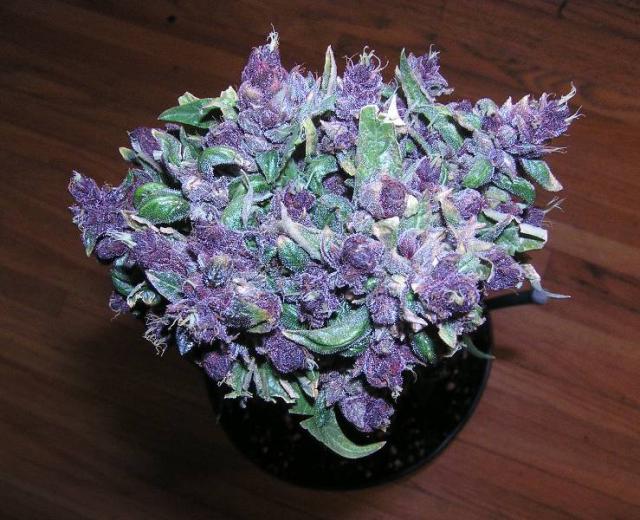
Colour is therefore a botanical trait, not a strain-identification test. A photograph lets you observe the colour of a particular specimen, but a purple leaf alone does not establish its name or ancestry. Lighting and the way a photograph is displayed also matter when comparing pictures. The image on this page retains the original photograph’s colours.
04 / IdentityRead the whole name
Keep the source, the full variety name and any additional label together. “Purple Haze” identifies the subject of this profile. “Feminized” describes a separate seed characteristic. A name containing “Purple Haze × …” identifies a cross, rather than simply another spelling of Purple Haze.
This distinction is especially useful in a strain library: related entries can be connected without merging their descriptions. For a second example of how a named strain is documented, explore our White Widow profile, which follows a different breeder-attributed history.
A photograph, not a colour filter
The photograph is identified as Purple Haze by its contributor. Look at the mixture of green and darker tones, the shape of the flower clusters and the small leaves around them. A strain named Purple Haze does not need to appear uniformly violet in every picture.
This is a reference image, not a photograph of a product supplied by this website. Its credit and reuse licence appear directly below it.
.jpg)