Quality of what?
A description might concern identity, physical appearance or a reported biological characteristic. These are different subjects. The word premium does not specify which one has been assessed.
Field notes / 05 · Understanding quality
Cannabis seed quality: reading claims and evidence
A convincing photograph and a convincing quality claim are different things. To understand what “good seeds” means in a description, start with the property being claimed, the material it refers to and the evidence behind it.
Explore the evidence ↘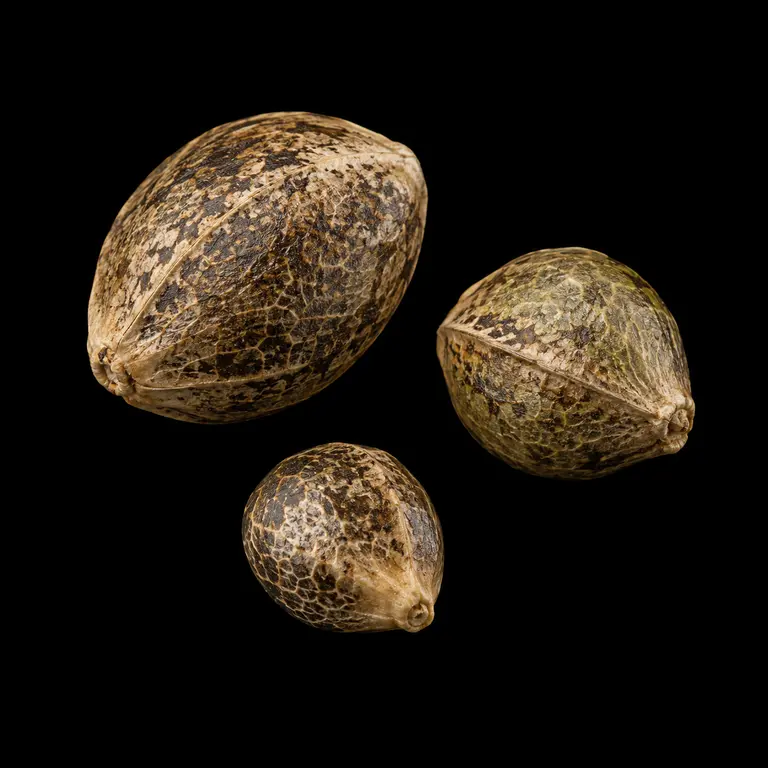
01 / Three questions behind “good”
Select a question to highlight its explanation. Together, these questions turn a broad adjective into something that can be discussed clearly. They are a framework for reading information, not a way to diagnose an individual seed.
A description might concern identity, physical appearance or a reported biological characteristic. These are different subjects. The word premium does not specify which one has been assessed.
A statement may refer to the pictured item, a submitted sample or a named lot. Read that reference carefully before extending the statement to other material.
A claim is easier to assess when it points to an identifiable source. A report title, issuer and material reference are more informative than an unattributed badge.
The missing noun
Tested for what, and reported about which material? The International Seed Testing Association separates fields such as purity, germination, viability and seed health. Its training also treats reporting and certificates as distinct areas of professional competence.
A general statement that material has been tested does not identify the result, scope or assessed property. Those details belong with the claim rather than being left for the reader to imagine.
02 / Understand the document
A percentage is incomplete until its meaning is known. A figure referring to purity answers a different question from one reporting germination. A document may contain several results because one number cannot stand for every aspect of seed quality.
| Document detail | Question it answers |
|---|---|
| Named property | What was assessed? |
| Sample or lot reference | What material does this document concern? |
| Relevant date | Which event happened, and when? |
| Issuer | Who is responsible for this report? |
| Scope and qualifications | What does the report cover, and what does it leave open? |
ISTA distinguishes a Blue International Seed Sample Certificate from its Seed Lot Certificates. Its accreditation FAQ explains that the sample certificate concerns the sample at receipt; lot certificates refer to the lot at sampling. Those are different scopes, even when the documents contain familiar-looking result fields.
This is a useful general reading principle: preserve the subject of the original statement. If a report says sample, a summary should not quietly replace that with every packet or every seed. The wording of the conclusion should remain as specific as the evidence allows.
These references explain professional reporting concepts. They do not mean that any product shown on this website has an ISTA certificate or has undergone an assessment by the organisations cited here.
03 / Four fictional descriptions
This phrase expresses a favourable description without defining a measured property. An informative account would identify what the name refers to and provide its source. The adjective alone cannot establish identity, provenance or a laboratory result.
The phrase names a setting but leaves the assessment unspecified. A useful supporting document would identify the property, material and issuer. It should be possible to connect the claim to the actual report rather than only to a decorative seal.
This is an appearance description. It can be appropriate beside an image, but it does not become evidence of every other quality someone might value. The same sentence should not silently shift from describing a surface to promising biological performance.
A packing date concerns a packaging event. Without another record, it does not establish when the material originated or when it was assessed. Our storage and shelf-life guide explains those dates in more detail.
Imagine a fictional archive containing a photograph, a specimen label and a report. Each may be useful on its own. Their combined value depends on whether they refer to the same material. A shared reference makes that connection explicit; a similar name does not necessarily do so.
Now imagine that the photograph is replaced by a generic illustration. The report has not changed, but the picture can no longer be treated as a documented view of that particular specimen. Clear captions prevent readers from inferring a connection the publisher has not established.
A photograph, a representative image and an illustration have different documentary roles. The image type belongs in its caption.
A familiar variety name is not the same as a unique material reference. One can appear in many descriptions without connecting their evidence.
The report should retain its original subject and scope when quoted elsewhere. A short summary should not make a broader promise.
Kew’s work on orchid seed viability uses specialist laboratory images and trained interpretation. Its account of machine learning describes expert annotation and the challenge of interpreting the images consistently. This is a specific scientific setting, not evidence that an ordinary exterior photograph reveals the same information.
The distinction is about context. Two images can both be close-ups while recording fundamentally different things. Knowing how an image was produced and what question it addresses is part of understanding what it can support.
For descriptive terms such as mottled, ovoid and reticulate, read the visual appearance reference. For the overall relationship between visible features, identity and quality, return to the parent knowledge guide.
Questions, untangled
By itself, it does not identify a test, measured property or result. Read the accompanying explanation before treating it as a technical assessment.
It can show an appearance. Claims about identity or biological characteristics need evidence that addresses those questions specifically.
It helps connect a result to its subject. Without that connection, a report may be authentic but unrelated to the material being described.
A reported proportion concerns a defined group and property. It should not be rewritten as a guarantee about each individual member.
The claim remains unsupported by a report available to the reader. That is a statement about the evidence provided, not a diagnosis of the material itself.
The wider context
Explore the central cannabis seed knowledge guide for an overview of biology, labels and related reading.