How much of one compound?
A concentration describes an amount relative to a stated quantity of material. It needs a unit and an identified sample.
Field notes / A19 · The knowledge library
High CBD vs Low THC Seeds: What the Labels Actually Mean
High CBD describes the CBD side of a chemical profile. Low THC describes the THC side. One does not automatically establish the other, and neither phrase tells you a complete laboratory result. On seed descriptions, these terms usually refer to the associated plant profile, rather than cannabinoid content inside the seed.
Explore the distinction ↘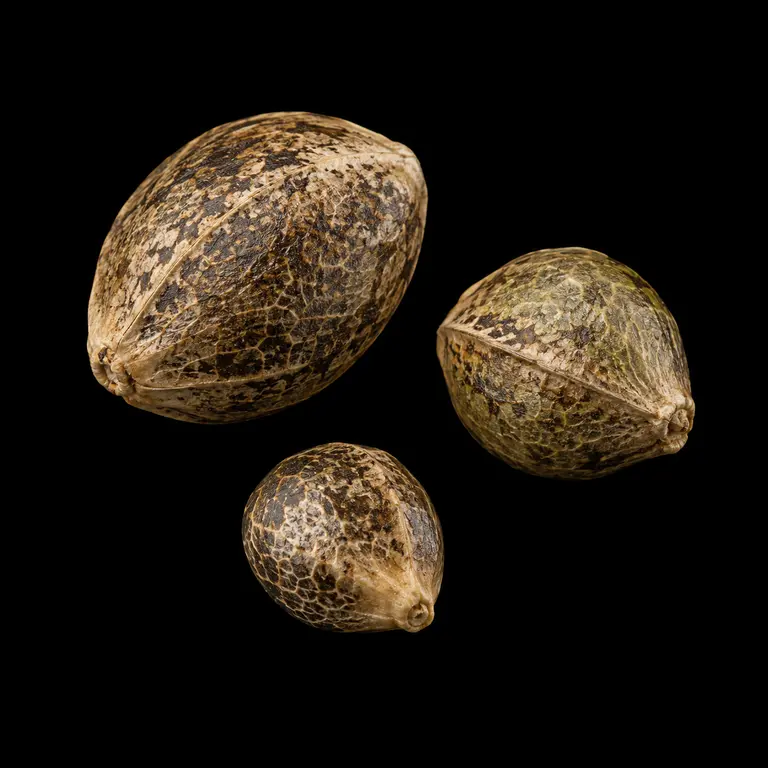
A concentration describes an amount relative to a stated quantity of material. It needs a unit and an identified sample.
A CBD:THC ratio compares CBD with THC. It does not by itself tell you the absolute amount of either compound.
A category name is a description. A laboratory report records results for the sample actually assessed.
CBD means cannabidiol. High CBD emphasizes its amount relative to a stated comparison; it does not supply the THC result.
THC commonly means tetrahydrocannabinol. Low THC concerns that compound’s amount; it does not establish a CBD concentration.
The FDA explains that cannabis seeds do not naturally contain THC or CBD. Trace amounts in seed-derived ingredients can arise through contact with other plant parts during harvesting and processing. This is why a seed-category description should not be read as a statement that the seed itself contains the advertised cannabinoid concentration.
Consider two fictional measurements, expressed in arbitrary units on the same basis. Sample A contains 10 units of CBD and 1 unit of THC. Sample B contains 20 units of CBD and 2 units of THC. Both have a CBD:THC ratio of 10:1, although neither compound has the same measured amount in the two samples.
Now compare a fictional Sample C with 10 units of CBD and 5 units of THC. Its CBD amount matches Sample A, but the ratio is 2:1. The examples show why a CBD figure, a THC figure and a ratio supply different information. These invented values are a mathematics illustration, not product specifications or legal thresholds.
| Sample | CBD units | THC units | CBD:THC |
|---|---|---|---|
| A | 10 | 1 | 10:1 |
| B | 20 | 2 | 10:1 |
| C | 10 | 5 | 2:1 |
The order of a ratio must also be explicit. CBD:THC and THC:CBD reverse the terms. Copying a ratio without its labels can therefore reverse the meaning, even when the numbers have been reproduced correctly.
A 2022 study of commercial cannabis chemistry found that familiar commercial labels did not consistently reflect the measured chemical diversity of the samples. Its findings support reading a measured profile on its own terms, rather than treating a name as a substitute for analysis.
For a straightforward comparison, keep the sample type, units and reported compounds visible. An amount expressed as a percentage and an amount expressed in milligrams are not directly interchangeable without knowing the quantity and basis involved. A result about one sample is also different from a general description of a named variety.
Laboratory notation can distinguish individual compounds and calculated totals. A reader should preserve the report’s exact terminology rather than silently replacing one entry with another. If two documents use different definitions, that difference must be resolved before their figures are compared.
This is a reading principle rather than a requirement to master an entire analytical method: compare like with like, retain the units, and keep the result attached to its sample.
The word low expresses a comparison. It does not express absence. Similarly, a result reported below a laboratory’s detection or reporting limit is not a mathematical proof that no molecule is present. The reporting convention determines what the statement means.
A legal definition is a further question. A concentration descriptor alone cannot establish legality across jurisdictions, sample types and activities. The cannabis seed law overview explains why the place, material and activity must be specified.
A useful description makes clear whether it refers to a variety, a specific lot or an analysed sample. For example, “described as CBD-rich by its source” and “CBD measured in this sample” are different forms of information. They should remain distinguishable on a profile page.
Neither a CBD label nor a THC label alone establishes a medical benefit, a suitable dose or a safety assessment. This article explains the language of composition. It does not turn that vocabulary into treatment advice.
For the broader relationship between names and measured traits, continue to cannabis genetics and strains. The key distinction remains useful throughout the library: a name identifies a description, while an analysis reports something about particular material.
Questions, untangled
No. The phrases concern different compounds. A CBD description does not supply the missing THC result.
No. It specifies a proportion when the order is stated. Different absolute amounts can share the same ratio, as the fictional examples above show.
No. Low is a comparative description, not a statement of complete absence.
Do not interpret it that way. Seed descriptions commonly refer to associated plant characteristics. The seed and an analysed flower sample are different materials.
No. A familiar name may help locate a description or history, but a chemical result belongs to the assessed sample and the method used.
CBD seeds explainedCannabis seeds versus hemp seedsCBD autoflower versus other CBD seedsCBD seeds without THC?Are feminized seeds always female?Can feminized plants produce seeds?How the feminized seed category arisesRegular CBD versus feminized CBDEarly female floral featuresPollen sacs and floral anatomyWhy female cannabis plants can contain seeds — Understand CBD seed terminology, CBD-rich and CBD-dominant descriptions, flowering and sex categories, and the difference between a seed label and a chemical result.