Where the story begins
The word records that a seed was encountered among flower. It does not require a special shape, colour or named variety.
Field notes / A07 · The knowledge library
What Is Bagseed? Meaning, Origin and Strain Identity
Bagseed is an informal word for a seed found in cannabis flower, often in a bag or package. It describes the circumstances of discovery. It is not a botanical variety, a sex category or a certificate of ancestry.
Explore the distinction ↘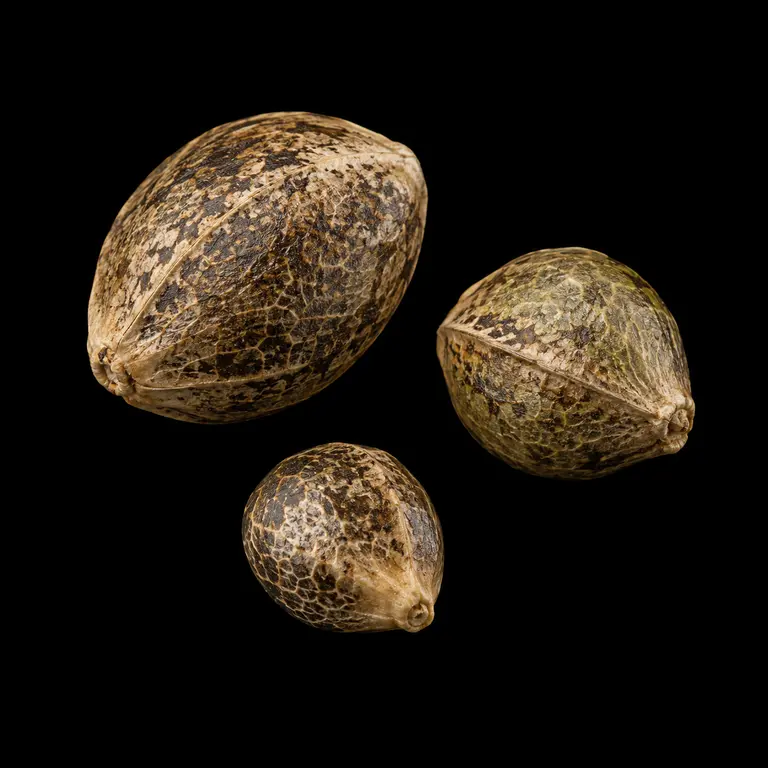
The word records that a seed was encountered among flower. It does not require a special shape, colour or named variety.
The name attached to the flower is an attribution. A record of the seed’s identity needs more than that association.
A reported discovery can be part of a strain’s history. Repeating the story should preserve who reported it and what was actually documented.
In ordinary cannabis vocabulary, bagseed points to an unexpected seed encountered with flower rather than a separately identified seed lot. Leafly’s glossary uses the term in this everyday sense. The container is incidental: the useful information is the association with the flower, not the packaging material.
Compare the sentences “a seed was found in this package” and “this is a documented sample of this cultivar.” The first describes an observation. The second identifies material. They can appear in the same account, but the first sentence does not establish the second.
This is why bagseed belongs in a different column from terms such as feminized or autoflower. Those labels concern other characteristics. Treating all three as competing types creates a classification that cannot explain what any individual label means.
A package labelled with a familiar strain name can give an account a starting point. It does not establish every parent involved in the seed’s origin. In sexual reproduction, the resulting embryo is not simply a copy of the surrounding maternal flower tissue. The connection between flower and seed therefore needs a more careful description than “the same strain, confirmed.”
Research by Sawler and colleagues found that names and reported ancestry did not reliably specify genetic identity across the material they examined. This finding supports caution about equating names with identity; it does not identify an unknown seed or invalidate every well-documented cultivar.
An editorial record might say: “One seed was reported in flower sold under the name Example A; no independent identity record was supplied.” Example A is fictional. The sentence preserves the useful association without converting it into a stronger finding. It also leaves room for later evidence rather than forcing an early conclusion.
| Statement | What it records |
|---|---|
| Found in flower | The reported discovery context |
| Flower labelled Example A | The name accompanying that material |
| Identity independently assessed | A separate assessment, whose method and scope matter |
A photograph can show the particular object described in a discovery story. Its caption should identify whether it is the original image, a later photograph of the same object or a general illustration. These are different kinds of visual evidence.
For example, “illustration accompanying an account of bagseed” is a clear caption for artwork. “The seed that founded this strain” is a historical claim. That stronger caption requires a connection between the photographed object and the event being described. An attractive close-up cannot supply that connection by itself.
The illustration on this page explains the subject visually. It is not a photograph of a documented bagseed discovery. For the vocabulary of visible seed features, continue to what cannabis seeds look like.
Origin stories often compress several events into one sentence. A discovery, a later naming decision and the circulation of material may be presented as though they happened together. Separating those events makes a history more interesting and more precise.
A useful profile can identify the earliest source for the account, explain whether it is a first-person recollection, and distinguish the original event from later retellings. Agreement between copied versions is not the same as several independent witnesses. Conversely, missing documentation does not prove a story false; it limits how confidently it can be presented.
Our strain profiles treat an attributed origin story as an attributed story. A claim about a present-day sample belongs in a different part of the profile. Readers can then enjoy the cultural history without mistaking it for an identity test. Explore the wider distinction in cannabis genetics and strain names.
Questions, untangled
No. It describes a discovery context. A named strain may have a reported bagseed origin, but that history does not make the word a cultivar name.
No. A missing record is not a positive identification as a different category. The discovery label does not establish a documented sex category.
No. The location of the discovery does not identify the pollen source. That is a separate ancestry question.
Yes. Attribute the account, preserve its uncertainty and distinguish it from evidence about currently described material. History and identification need different records.
The word itself is not a quality grade. It reports where a seed was encountered, without supplying a measured assessment of its condition or identity.