The embryonic seed leaves
Cannabis is a dicotyledonous plant. Cotyledons belong to the embryo and are distinct from the later foliage called true leaves.
Field notes / 16 · The knowledge library
What Does a Cannabis Seedling Look Like? A Botanical Reference
A cannabis seedling does not begin as a miniature version of the familiar many-pointed leaf icon. Botanical descriptions distinguish the embryonic seed leaves from the first true leaves and later, more divided foliage. This reference explains that vocabulary.
Explore the distinction ↘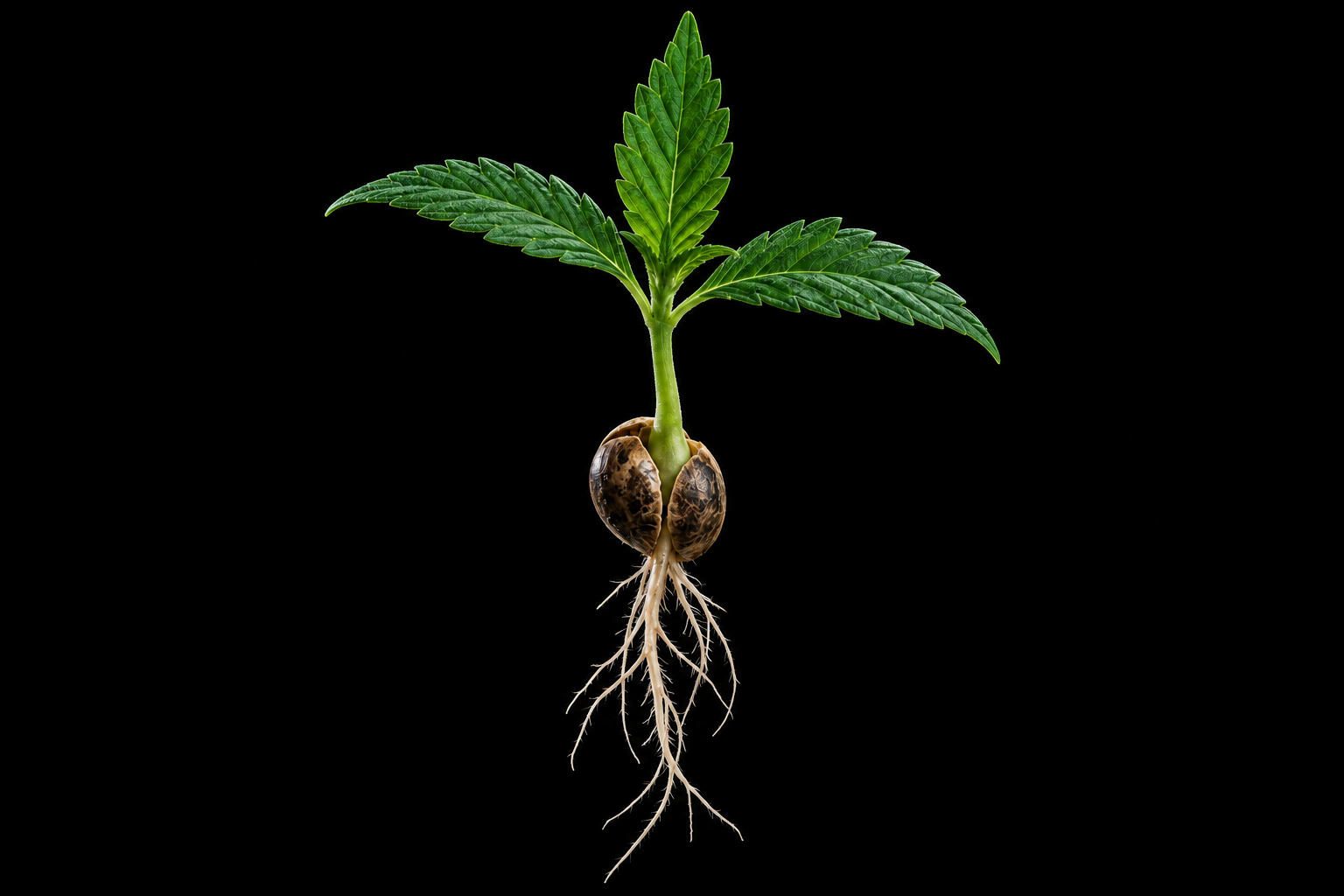
Cannabis is a dicotyledonous plant. Cotyledons belong to the embryo and are distinct from the later foliage called true leaves.
Cannabis morphology research describes the first true leaves as single serrated leaflets after cotyledon expansion. Later foliage has a different form.
A leaflet is one division of a compound leaf. A whole leaf and one of its leaflets are not the same unit, even when a drawing makes the distinction hard to see.
The many-pointed cannabis leaf is a strong visual shorthand. Logos often use it because it is recognisable. But a symbol is a compressed representation of a subject, not a complete botanical account of development.
Young foliage and later foliage can look different. That does not make the developmental description contradictory: the subject has changed over time. A source should say which stage its image represents rather than treating one silhouette as universal.
| Term | What it names |
|---|---|
| Cotyledon | An embryonic seed leaf |
| True leaf | Foliage distinct from the cotyledons |
| Leaflet | A division of a compound leaf |
| Leaf margin | The edge of the blade |
| Serrated | An edge described as tooth-like |
These terms are descriptive. They help explain what a source is showing without turning a resemblance into proof of identity or condition.
A 2023 morphological study of Cannabis sativa documented a sequence from cotyledon expansion to the first true leaves, followed by later changes in leaf form. Its descriptions distinguish the early single serrated leaflets from subsequent foliage.
That study is evidence about the material it examined. Its developmental vocabulary is useful, but its images should not become a claim that every specimen has identical proportions at an identical age.
A separate published study of cannabis seedling tissues also distinguished cotyledons, hypocotyls and the first pair of true leaves. Here, those structure names are relevant as anatomical vocabulary; the experimental procedures are outside this article’s scope.
The hypocotyl is the portion of the embryonic axis below the cotyledons. Naming it can make an anatomical description more precise than referring vaguely to the entire structure as a stem. Precision matters when two captions discuss different parts of one plant.
A photograph can document a specimen. A botanical drawing may simplify the view to explain a structure. A stylised illustration may combine stages or exaggerate proportions. Each can be useful, but their documentary roles differ.
The illustration on this page is a symbolic composition, not an anatomical plate or a photographed example of a precisely dated seedling. It should not be used to measure proportions, assign an age or identify an unknown specimen.
| Detail | What it clarifies |
|---|---|
| Stage caption | Which developmental state is represented |
| Scale | Whether physical dimensions can be inferred |
| Source | Where the image or specimen record comes from |
| Image type | Whether the view is photographic, diagrammatic or illustrative |
Cropping can hide relevant context. A close-up of one blade may omit its attachment, the rest of the leaf or the wider plant. A reader should not assume that everything outside the frame is absent from the specimen.
Lighting and display choices also affect the impression of colour and surface. A visible description should stay close to what the image actually shows rather than silently becoming a diagnosis.
“A pair of simple leaves is visible” is an observation. “This is a particular cultivar” is an identity claim. “This specimen is healthy” is a condition claim. Moving from the first statement to either of the others requires evidence relevant to that new question.
A fictional educational caption might say: “Young foliage is shown above the cotyledons; the image is enlarged and has no physical scale.” That caption gives useful orientation without claiming a precise age or a universal appearance.
Likewise, a caption calling a leaf serrated names its margin. It does not identify the plant’s sex, chemical composition or flowering category. Those characteristics are not alternate meanings of the word serrated.
The seed sex-label article discusses a related limit of visual evidence. The reproductive-biology reference explains flower terminology as a separate botanical subject.
Two photographs may show different developmental states without providing a complete chronology. Even if their captions contain dates, the record needs a defined starting point before those dates can be interpreted as an age.
For the distinction between germination, emergence and young-plant development, read from germination to seedling. That article concerns the meaning of stages and intervals, while this one focuses on visible structures.
Both support the same principle: use the right word for the subject actually described. A clear botanical label gives the reader a way to understand an image; it does not need to promise more than the evidence can establish.
Questions, untangled
No. Cotyledons are embryonic seed leaves. Botanical descriptions distinguish them from later foliage.
No. Published cannabis morphology research describes simpler early true leaves before later changes in leaf form.
No. A leaflet is one division of a compound leaf. Captions should distinguish the two units.
No. It is a symbolic illustration, not a verified identification key or a diagnostic specimen photograph.
Not on its own. A documented chronology and starting event are needed to interpret age.
The wider context
Explore the central cannabis seed knowledge guide for an overview of biology, labels and related reading.