What the image shows.
A seed image can display an outline and a surface pattern. Calling that outline rounder or that pattern darker describes the view; it does not establish a sex-linked relationship.
Field notes / 06 · Beyond appearances
Can you tell male and female cannabis seeds apart by looking?
You should not assign male or female identity to a cannabis seed from its colour, markings or outline alone. The research discussed here examines genetics and reproductive traits; it does not establish a dependable visual rule for sorting dry seeds by sex.
Explore the distinction ↘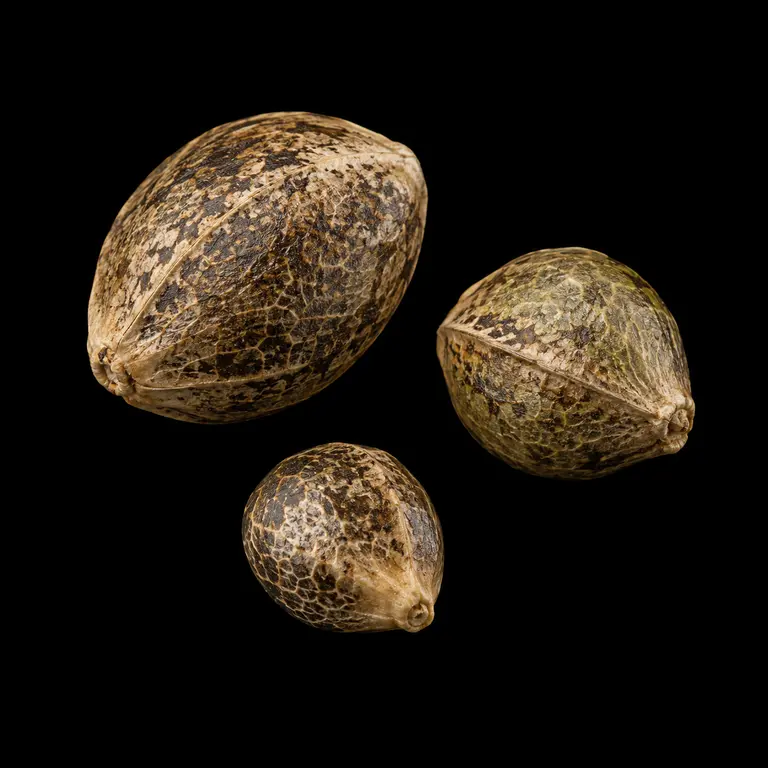
01 / Three kinds of information
These words describe different aspects of the subject. Select one to highlight its meaning. Keeping them separate prevents a visible feature from being mistaken for a genetic result, or a genetic description from being treated as a complete account of every later trait.
A seed image can display an outline and a surface pattern. Calling that outline rounder or that pattern darker describes the view; it does not establish a sex-linked relationship.
Research describes an XX/XY sex-chromosome system in dioecious cannabis, with females generally XX and males generally XY. Chromosome information is not a colour code visible on the seed surface.
Sex expression concerns reproductive characteristics. Studies also discuss plants expressing both male and female traits, making a simple picture-based binary an incomplete account of the biology.
02 / Read the biological terms
Dioecious means that male and female flowers occur on separate individuals. Monoecious describes male and female flowers on the same individual. These are terms about reproductive organisation, not two different seed shapes.
A 2020 genome-wide study of hemp investigated the genetic architecture of sex determination. Its subject was the relationship between genetic variation and traits. It was not a chart assigning sex from surface markings.
A published study on early sex identification compared molecular findings with later male or female floral appearance. Its evidence concerns genetic markers and observed reproductive traits, rather than an exterior seed photograph.
A separate study examined cannabis inflorescences with both male and female characteristics. It explored floral morphology and genetic variation, illustrating why chromosome terminology and the description of expressed traits should remain distinct.
These examples explain the kind of evidence used in research. They are not instructions for performing a test or identifying plants in cultivation. Their relevance here is conceptual: a scientific conclusion depends on the observations that support it.
When a social-media graphic claims to distinguish seed sex, it is making a different claim from these studies. A citation about chromosomes does not automatically validate a rule about shell shape. The evidence needs to address the actual feature and prediction shown in the graphic.
03 / Reading visual claims
Two enlarged seeds, coloured labels and a bold dividing line can make a comparison feel authoritative. But the arrangement of a graphic does not tell you how the labels were established, how many examples were considered or whether the proposed distinction works beyond the displayed pair.
| Claim | What it would need to establish |
|---|---|
| “This outline means female.” | A demonstrated relationship between the stated outline and independently established sex. |
| “Dark markings mean male.” | Evidence about markings and sex, not simply a photograph with a label. |
| “This diagram proves it.” | An identifiable study behind the diagram and a clear account of what was measured. |
| “It worked once.” | Evidence that separates a repeatable association from a single matching outcome. |
Consider a fictional example unrelated to plants: someone predicts the contents of a sealed envelope from its colour and happens to be right. That outcome alone does not establish that envelope colour predicts the contents. The same reasoning applies when a visual prediction is presented without supporting research.
It is also possible for a photograph to be correctly labelled without its visible features explaining the label. A curator may know a specimen’s identity from a record. The caption communicates that knowledge; it does not prove a stranger could recover the identity from appearance alone.
04 / A label is another kind of information
In seed descriptions, feminized refers to an intended female outcome associated with the material’s breeding background. It is not a botanical term for stripes, a particular shade or a visible outline. Reading the term therefore involves the description and its source, rather than matching a seed to a picture.
Likewise, regular and feminized are category terms. Neither supplies an individual specimen’s full history merely by appearing beside it. Our feminized seeds page and regular seeds page explain how the labels are used in the wider catalogue.
Imagine a fictional page carrying a feminized label and a generic seed illustration. The label belongs to the written description. The image illustrates the subject. Unless the publisher establishes a stronger connection, the illustration should not be presented as a documented female specimen.
That is why this article assigns no male or female identities to its three illustrated seeds. Creating a labelled pair would suggest that the images demonstrate the very distinction the article explains they cannot establish.
For a vocabulary of visible features, continue to our seed appearance reference. For help interpreting wider promises and reports, read quality claims and evidence. Those articles address appearance and documentation without turning either into a visual sex test.
Questions, untangled
The sources reviewed here do not establish a reliable colour rule. A colour observation should not be presented as a determination of sex.
Feminized is a description of the material and its intended outcome, not the name of a shell pattern. The label cannot be inferred from an illustration alone.
No. These terms refer to chromosomes, not markings on the exterior. A seed photograph does not display that genetic information.
No. Dioecious describes male and female flowers occurring on separate individuals. Feminized is a seed-category term. They answer different questions.
Without documented identities, that would invent a distinction. Even with documented identities, two pictures alone would not validate a general rule for identifying other seeds by appearance.
The wider context
Explore the central cannabis seed knowledge guide for an overview of biology, labels and related reading.