Seed or associated material?
The seed itself and the plant profile described by a seed label are different analytical subjects.
Field notes / A23 · The knowledge library
CBD Seeds Without THC? Understanding Zero, Low and Unreported
CBD seeds without THC can refer to two different questions: what is present in a seed, or what a description claims about associated plant material. A CBD seed label alone cannot guarantee a THC-free plant profile. The words zero, low and not reported also need to stay distinct.
Explore the distinction ↘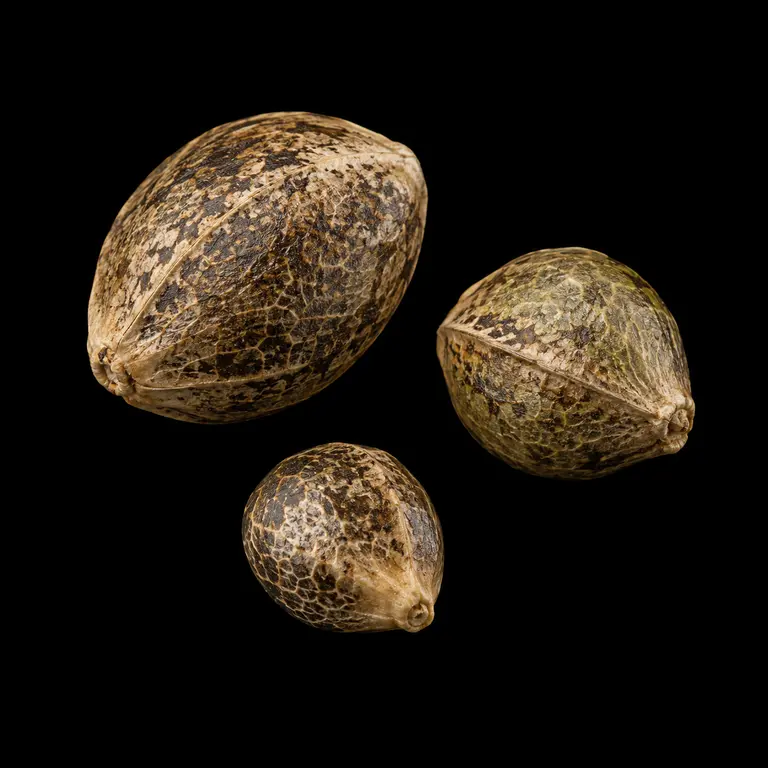
The seed itself and the plant profile described by a seed label are different analytical subjects.
Low is a comparison. Zero is an absolute statement. An omitted result supplies neither.
A general description, a particular sample result and a whole-category promise are different levels of evidence.
The FDA explains that cannabis seeds do not naturally contain THC or CBD, while seed-derived ingredients may acquire trace amounts through contact with other plant parts. That ingredient context should not be converted into a claim about the cannabinoid profile of plant material associated with a seed category.
This is why the complete question matters. “Does the seed naturally contain THC?” and “Does this seed description establish a THC-free plant profile?” ask about different things. Answering the first does not settle the second.
The hemp seed ingredient article addresses seeds and seed oil. The CBD seed guide explains the category label. This page focuses on the meaning of a claim that THC is absent.
| Wording | What it says |
|---|---|
| Low THC | A comparative amount, whose reference needs to be stated |
| THC-free or zero THC | A claim of absence that needs an explicit basis |
| THC not reported | The description supplies no THC result |
| CBD-dominant | A comparative cannabinoid description, not complete absence of THC |
A common reading error is to turn missing information into a reassuring result. A description that lists CBD but omits THC has not thereby reported zero THC. The omission is an information gap, not a measurement.
Likewise, low does not become zero because the amount is described as small. A comparison and an absence claim have different meanings. Preserving that distinction is necessary even before considering how a particular result was obtained.
If a report uses a qualified expression, such as a value below a stated reporting limit, retain its qualification. Rewriting it as an unqualified zero changes the statement. This is a general principle for reading analytical reports, not a result assigned to any product on this site.
A ratio expresses a relationship between quantities. It does not state their absolute amounts.
This is a claim of absence. A ratio containing a nonzero THC term is not another way of expressing zero.
For simple fictional numerical examples, see high CBD versus low THC. The examples show why identical ratios can coexist with different amounts, without assigning numbers to real products.
A measurement has a subject. A laboratory report about assessed material is different from a promise covering every item that might later carry the same name. Keeping the sample attached to the result prevents the scope of the statement from expanding unnoticed.
Research by Watts and colleagues examines relationships among cannabis labels, genetics and chemical variation. It is part of the evidence for taking the underlying variation seriously rather than treating familiar labels as a full analytical description.
A fictional statement such as “no THC result appears in this profile” is simply an observation about a document. Changing it to “this named category contains no THC” turns missing documentation into a chemical claim. Changing it again to “all material with this name is THC-free” adds an even broader claim. Each step would need evidence the original sentence did not contain.
A THC-related statement is not a complete health assessment. A composition claim cannot, by itself, determine whether a product is appropriate for an individual or establish a therapeutic benefit. This article explains language and evidence, not treatment or dosing.
Legal definitions also have their own scope. A label saying low THC or THC-free does not identify the applicable jurisdiction, material and activity. Those details matter independently of the phrase on the label. The legal overview explains the distinction.
For the original question, the answer remains specific: do not treat a CBD seed label as a guarantee of a THC-free plant profile. Identify what material the statement concerns, preserve any qualification in the result and distinguish missing information from a reported absence.
Questions, untangled
No. A CBD-related description alone does not establish that THC is absent.
Not necessarily. An omitted value is missing information, rather than a reported zero.
No. One is comparative and the other claims absence. They need different wording and evidence.
A result describes the material assessed. Extending it to all material carrying a name is a broader claim requiring additional support.
No. It explains how to interpret the wording. No product-specific THC-free guarantee is made here.