Ovoid & compressed.
Ovoid means egg-shaped in three dimensions. Compressed describes a form that is somewhat flattened. These terms can appear together because one describes the overall shape and the other describes its proportions.
Field notes / 04 · A visual reference
What do weed seeds look like?
Cannabis seeds are small, broadly oval units, often with a mottled or marbled surface. Botanical descriptions record variation in colour, outline and markings. This visual reference translates those descriptions into plain English, one feature at a time.
Open the visual glossary ↘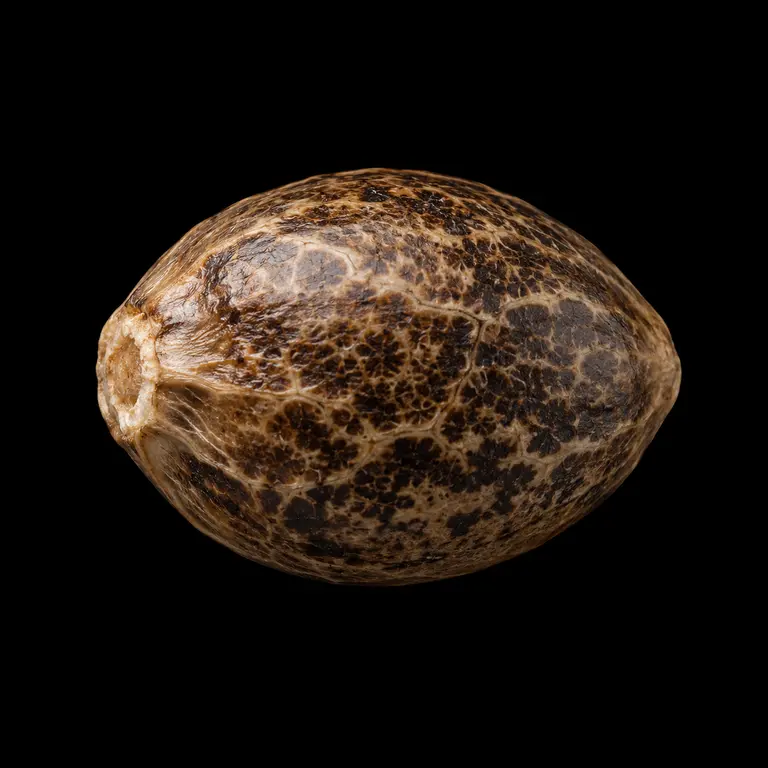
01 / Translate the field description
Select a feature to highlight its vocabulary. Keeping these categories separate makes a description more precise: an object can have an oval shape, an uneven colour pattern and a shiny surface at the same time.
Ovoid means egg-shaped in three dimensions. Compressed describes a form that is somewhat flattened. These terms can appear together because one describes the overall shape and the other describes its proportions.
Reticulate means net-like. Mottled describes irregular patches of colour or tone. A network and a patchwork are different visual ideas, even when both are visible on the same object.
Flora accounts include greyish and brownish tones as well as paler colours and contrasting markings. A single brown illustration should therefore not be treated as the only possible appearance.
A botanical translation
The whole unit commonly called a cannabis seed is botanically a small fruit called an achene. A description of its visible exterior may therefore refer to the fruit wall rather than only to the enclosed seed.
Flora of China uses the term pericarp for that fruit wall. Knowing this word helps you connect an everyday seed photograph with the anatomy described in a flora, without assuming that the two sources are discussing different objects.
02 / Bring the scale back
Flora of North America and Flora of China describe cannabis achenes in the range of 2–5 millimetres. That is a botanical description of the material covered by those accounts, rather than a promised dimension for every named commercial variety.
A full-screen close-up can make such a small object look substantial. The image’s displayed width is a layout choice; it is not a measurement of the specimen. That distinction remains true whether you view the article on a phone or a large monitor.
| Term | Meaning | Example |
|---|---|---|
| Physical dimension | The measured extent of the object | A length stated in millimetres |
| Image dimension | The pixel dimensions of the file | A square image file |
| Display dimension | The space occupied in the layout | A large image beside a title |
Only the first row describes the physical size of the subject. A scale bar or a documented measurement can connect the image to that subject. An illustration without a scale should remain labelled as such rather than invite an estimate from screen size.
03 / Read two floras together
This account describes ovoid, somewhat compressed achenes and records mottling. It also mentions a persistent floral covering that may flake away. The description gives context to a surface that is not necessarily uniform.
This account emphasises a flattened ovoid form and a finely net-like fruit wall. Its compact description concentrates on form and surface structure.
These are botanical treatments, not advertising descriptions of individual seed packets. They provide a vocabulary for recognising and discussing features. They do not turn each feature into a pass-or-fail rule.
A short account may mention outline while another spends more words on markings. The absence of a particular adjective does not automatically mean the author observed its opposite. Compare what each source actually says before treating the descriptions as conflicting.
This is especially useful when reading simplified captions. “Oval brown seed” is a broad description; “compressed ovoid achene with a net-like surface” is a more technical one. The second adds anatomical precision. It does not necessarily describe a different specimen.
04 / Put the details into words
Here is an example written for the illustration on this page: “An enlarged botanical illustration showing an oval outline, brown and pale markings, and a network-like surface pattern. No physical scale is supplied.”
That caption names visible features and identifies the image type. It makes no claim about a particular variety, the sex of a future plant or the biological condition of a real specimen. Those would be additional questions requiring different evidence.
Use a word such as oval when describing the visible silhouette. Reserve a three-dimensional term for a view or source that supports it.
Distinguish patches, networks and highlights. A bright reflection is a lighting feature in the image, not necessarily a pale marking on the object.
Say whether the reader is looking at a photograph, a drawing or an illustration. Include a source and scale when those are available.
For the broader question of what appearance can tell you about quality, continue to the appearance and quality knowledge guide. This article supplies the descriptive vocabulary; the parent guide considers the interpretation of evidence.
Questions, untangled
No single shade represents all the variation recorded in botanical accounts. Descriptions include paler and darker colours and contrasting surface patterns.
It means net-like. In a botanical description, it identifies the character of a pattern or surface structure rather than a commercial seed category.
In the flora descriptions used here, it describes a somewhat flattened shape. It is a morphological term, not a statement that someone crushed the specimen.
Not by itself. Image enlargement and physical size are separate. A documented measurement or scale is needed to connect the two.
It illustrates vocabulary, rather than serving as a verified identification key. Similar-looking objects should not be assigned an identity solely because they resemble one illustration.
The wider context
Explore the central cannabis seed knowledge guide for an overview of biology, labels and related reading.