An intended female outcome
The term describes the sex-related intention associated with the seed line. It does not state every other biological characteristic or establish a result for a particular specimen.
Field notes / 09 · The knowledge library
Feminized vs Regular Seeds: Meaning, Sex Ratios and Labels
Feminized and regular describe different sex-related seed categories. Feminized material is intended to produce female plants; regular material can include male and female offspring. Neither label is a complete description of a variety or a quality grade.
Explore the distinction ↘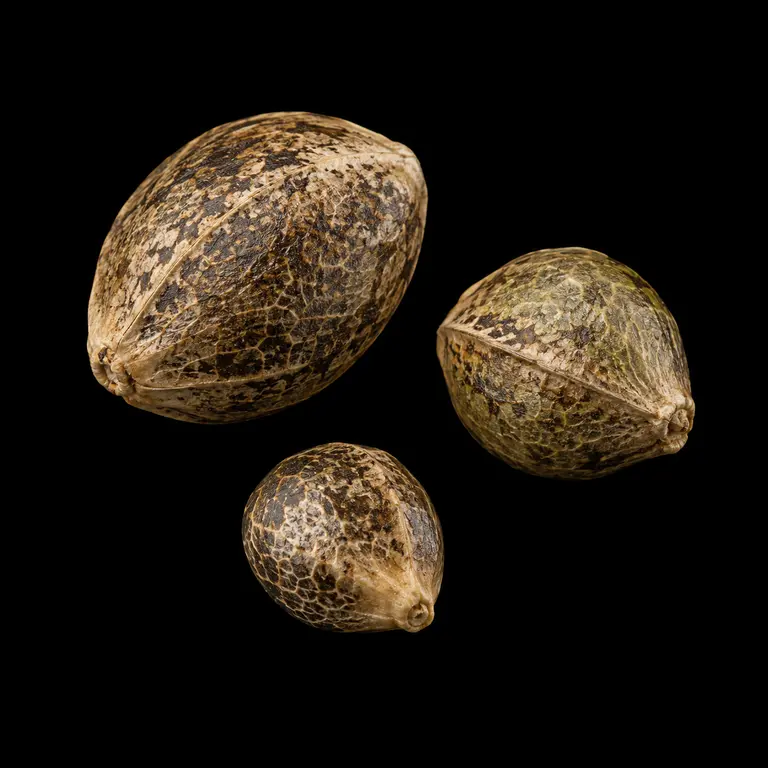
The term describes the sex-related intention associated with the seed line. It does not state every other biological characteristic or establish a result for a particular specimen.
Regular is commonly used for seed material not designated feminized, with male and female offspring possible. It does not mean ordinary quality or an inferior version.
A sex ratio describes the composition of a defined group. It is different from identifying each individual member, and it should retain the scope of the original observation.
Unlike autoflower versus feminized, this comparison concerns two labels used along the same descriptive dimension. It asks how the seed material is characterised in relation to sex. A flowering-response term, a strain name and a chemical-profile description each add different information.
| Description | Feminized | Regular |
|---|---|---|
| Sex-related meaning | Intended female outcome | Male and female offspring possible |
| Flowering response | Not specified by this word alone | Not specified by this word alone |
| Visible shell pattern | No diagnostic pattern established here | No diagnostic pattern established here |
| Quality ranking | Not a quality score | Not a quality score |
A menu may separate the categories, but its layout cannot answer questions that the labels leave open. For example, the word regular does not itself identify a photoperiod response, and feminized does not automatically mean autoflowering. Each additional claim belongs in its own description.
Dioecious cannabis has male and female flowers on separate individuals. Research describes a sex-chromosome system in which females are generally XX and males generally XY. Studies of feminized seed concern sex expression and progeny, while other research examines variation in reproductive expression.
These concepts explain why the category terminology is sex-related. They do not turn a commercial label into a laboratory finding about an unidentified seed. The genetic model, the description of a seed line and the record of an actual sample remain separate pieces of information.
The 2021 study cited below investigated feminized cannabis seed in specified breeding material. Its findings belong to that study. Citing it as background does not establish that every product using the same category word has identical characteristics.
The distinction also prevents an unhelpful comparison between “natural” and “artificial” as though those words were measured grades. Such adjectives can express a viewpoint without describing provenance, genetic identity or a documented result. This article compares what the labels mean, rather than ranking them.
A ratio has a subject: the group whose members were counted or whose outcomes were modelled. A statement about a broad population should not be silently rewritten as an exact count for every smaller subset. Small groups can differ from the overall pattern without changing what the original statistic means.
Think of a fictional bag of counters containing two colours. Describing the composition of the full bag does not specify the colour of each counter in an unseen handful. This is an analogy about interpreting a group statistic, not a model of a particular seed lot.
Likewise, “intended female outcome” and “every individual has been independently identified” are different claims. An exact numerical promise needs its own stated basis, material reference and scope. The category word alone does not supply those details.
| Statement type | What the reader should understand |
|---|---|
| Category description | How the material is presented |
| Observed result | What was recorded for specified material |
| Prediction or guarantee | What is being claimed beyond the observation |
The most useful wording preserves the level of evidence. If a source describes a sample, its summary should describe that sample. If a publisher makes a broader promise, that promise should be identifiable as an additional claim.
“Regular White Widow” names a category and a strain identity as presented by its source. It does not, by itself, provide a unique lot reference, a photograph of the actual material or a complete specification. “Feminized White Widow” adds a different category description but leaves the same documentary questions open.
A familiar name can occur in more than one source. That makes attribution useful: readers need to know which description they are reading before treating it as interchangeable with another. Similar names should not erase differences between source records.
The same applies to photographs. An attractive seed image can illustrate the topic without proving its category. Our male or female seed article explains the difference between an exterior observation and sex-related evidence.
For the wider catalogue context, see Feminized seeds and Regular seeds. If the question is about flowering labels instead, continue to autoflower, regular and photoperiod terminology.
Questions, untangled
No. It is a seed-category term. Quality claims concern other properties and require their own evidence.
No. Feminized concerns the intended sex-related outcome; autoflower concerns flowering response. The two labels can appear together.
No exact packet composition is established by the category word. A group-level ratio and an individual packet count are different statements.
An exterior seed photograph does not establish a regular or feminized designation. The classification belongs to the description and its supporting record.
Our quality and evidence article explains why category, identity and a reported result are separate concepts.
The wider context
Explore the central cannabis seed knowledge guide for an overview of biology, labels and related reading.
Regular seeds explained — A knowledge guide to regular cannabis seeds: what regular means, how it differs from feminized and autoflower, and why a seed category is not a complete genetic identity.
Are feminized seeds always female? · Can feminized plants produce seeds? · How the feminized seed category arisesRegular CBD versus feminized CBDEarly female floral featuresPollen sacs and floral anatomyWhy female cannabis plants can contain seeds