Which chapter of the life cycle?
Germination, emergence and seedling development are related but different descriptions. Naming the chapter makes a photograph or a timing statement easier to interpret.
Field notes / H09 · The knowledge library
Cannabis Seedlings Explained: Development, Structure and Observation
A cannabis seedling is a young plant in a developmental period, not a single shape or an exact age. This guide connects the vocabulary of early structures, the interpretation of images and the meaning of stage descriptions, with links to the detailed articles.
Explore the distinction ↘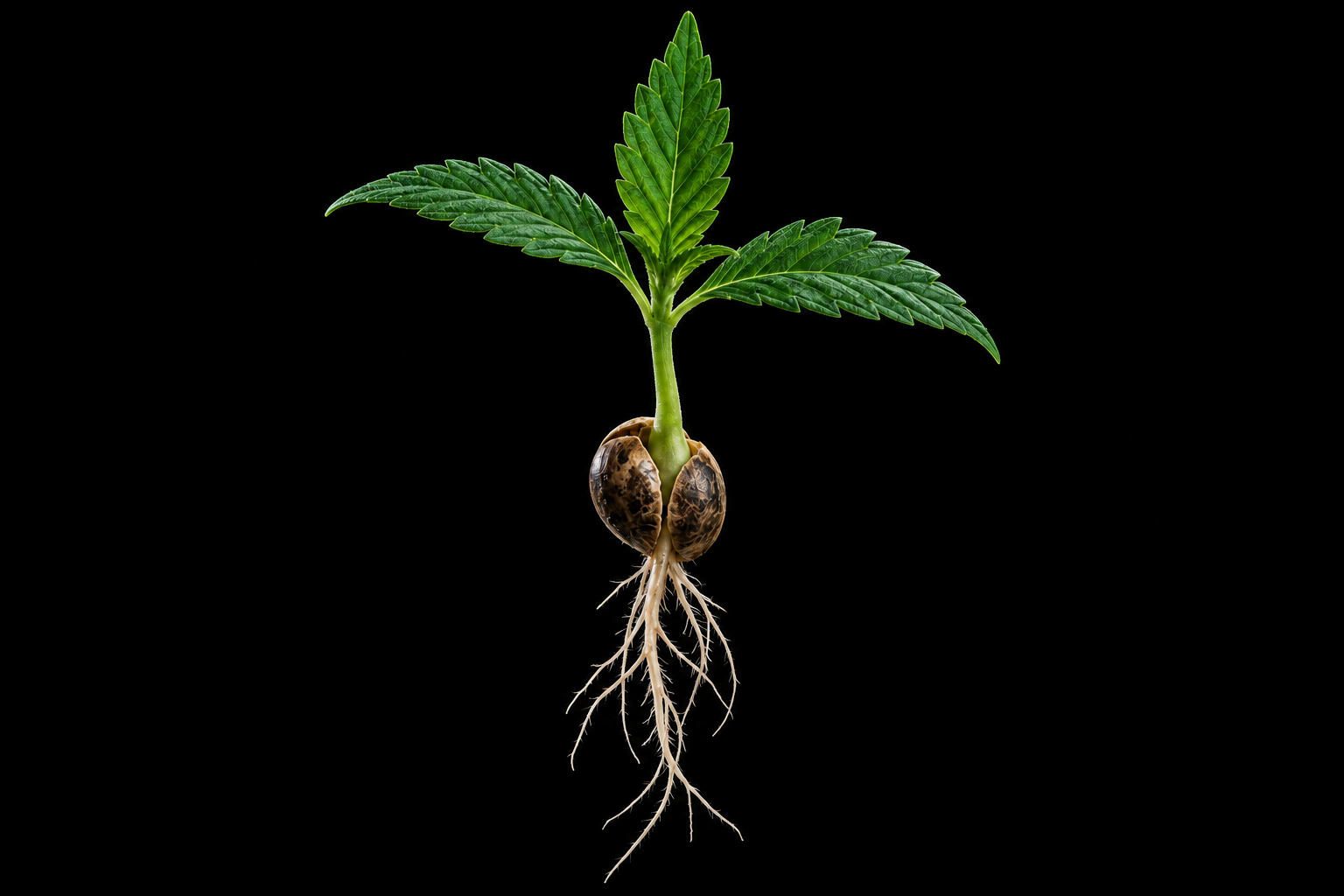
Germination, emergence and seedling development are related but different descriptions. Naming the chapter makes a photograph or a timing statement easier to interpret.
Cotyledons, true leaves and leaflets name different botanical units. The right term explains an image more precisely than referring to every green part as the same kind of leaf.
A picture can document visible form. Identity, age and condition are additional claims, each requiring information beyond a generic resemblance.
The word seedling is useful because it identifies a young-plant stage without pretending that every specimen reaches an identical appearance at an identical age. A more specific account should describe the structures or milestone being discussed.
Germination is a physiological process. Seed physiology commonly uses the emergence of the embryonic root as its endpoint. A leafy young plant represents subsequent development, so the two views should not be treated as photographs of one event.
Emergence also needs a subject. Radicle emergence describes a root; seedling emergence may describe a young plant becoming visible above a surface. An account should preserve that distinction when it reports elapsed time.
| Word | Scope |
|---|---|
| Germination | A physiological transition with a defined endpoint |
| Radicle | The embryonic root |
| Emergence | An appearance or transition whose subject must be named |
| Seedling | A young-plant developmental period |
The germination knowledge guide covers the first process. The article on emergence and timing explores how the later interval is described.
Cannabis is a dicotyledonous plant. Botanical accounts distinguish its cotyledons, or embryonic seed leaves, from later true leaves. A published morphology study describes early true leaves with single serrated leaflets before later changes in foliage form.
That is why a familiar many-pointed leaf symbol should not stand for every developmental state. The symbol is visual shorthand; the botanical description follows structures as they change.
Leaf and leaflet are also different units. In a compound leaf, leaflets are its divisions. Counting points in a stylised icon is not the same as identifying those units in a documented botanical view.
| Term | Meaning |
|---|---|
| Cotyledon | An embryonic seed leaf |
| True leaf | Later foliage distinct from the cotyledons |
| Leaflet | A division of a compound leaf |
| Hypocotyl | The part of the embryonic axis below the cotyledons |
For a closer discussion of those words, use the seedling appearance reference. It explains what an image label names without treating an illustration as an identification key.
A photograph can record a specimen. A diagram can explain relationships between structures. A stylised illustration can introduce a subject by combining ideas. These are different roles rather than different levels of visual attractiveness.
The symbolic imagery in this library is labelled accordingly. It does not document a precisely aged seedling, a verified cultivar or an anatomical measurement. Treating an illustration as evidence for any of those claims would ask it to do a job it was not made to do.
A caption can be brief and still supply valuable context: what is shown, whether the view is photographic or illustrative, and whether a scale or specimen record exists. If the image omits those details, the reader should not invent them.
Cropping matters as well. A close-up may show one blade while omitting its attachment and the rest of the plant. Something outside the frame has not necessarily been shown to be absent from the specimen.
The same principle applies to colour. Lighting, recording and display affect the impression of a photograph. A colour description should not quietly become a diagnosis.
“Two leaves are visible” is an observation. “The plant belongs to a named cultivar” is an identity statement. “The specimen is healthy” is a condition claim. They may all concern one subject, but they are not interchangeable conclusions.
A visible feature can be described clearly while the wider condition remains unknown. That is not a failure of the description; it is a recognition of what the record actually contains.
For example, a fictional archive label says that a photograph shows young foliage. Another record names the specimen’s source. The photograph and source record complement each other. Neither automatically establishes every possible claim about the subject.
The library therefore does not use a generic seedling image to diagnose individual plants. Its role is to teach the vocabulary of stages and structures and to explain the difference between evidence and an assumption.
The quality-evidence guide applies similar reasoning to seed claims. The seed sex-label article addresses another example of a conclusion that appearance alone does not establish.
A developmental study examines particular material within a defined context. Its observations can explain a sequence without proving that every specimen will have matching proportions at matching dates. A source summary should preserve the difference between a described pattern and a universal prediction.
A first observation and an exact event time are also different records. If checks occur at separate times, the event may fall between them. Additional detail in a caption should reflect actual evidence rather than invented precision.
Studies may use stage codes to classify observations. Such a code is a vocabulary tool, not automatically a calendar age. The definition attached to the code matters more than a number taken out of its context.
For environmental terminology, the articles on light and temperature explain how research variables are described. They do not supply a cultivation programme or a diagnosis of an individual plant.
Use the appearance reference for structural terms. Use the emergence article for event definitions and intervals. Use the germination guide for the earlier physiological process. Keeping those questions distinct avoids making one page repeat every detail of the others.
Questions about reproductive structures belong to the male and female plant biology reference. Questions about cultivar identity belong to the genetics and strains guide. Ordinary young foliage is not a substitute for either kind of evidence.
The wider cannabis seed knowledge guide connects the full library. This page’s purpose is narrower: it provides the vocabulary that lets a reader understand young-plant descriptions without confusing stage, structure, age and condition.
Questions, untangled
No. It names a developmental period. Precise comparisons need a defined stage or recorded event.
No. Cotyledons are embryonic seed leaves; true leaves describe later foliage.
Not on its own. A cultivar claim requires a source or identity record rather than a generic visual resemblance.
No. It explains botanical vocabulary and the interpretation of observations.
Read from germination to seedling for the difference between a developmental event and an elapsed interval.